Why do fireworks have different colors?
The short answer
Fireworks glow red, green, blue, and other colors because materials inside them give off colored light when heated. Different materials tend to produce different kinds of light, so fireworks can appear in many colors.
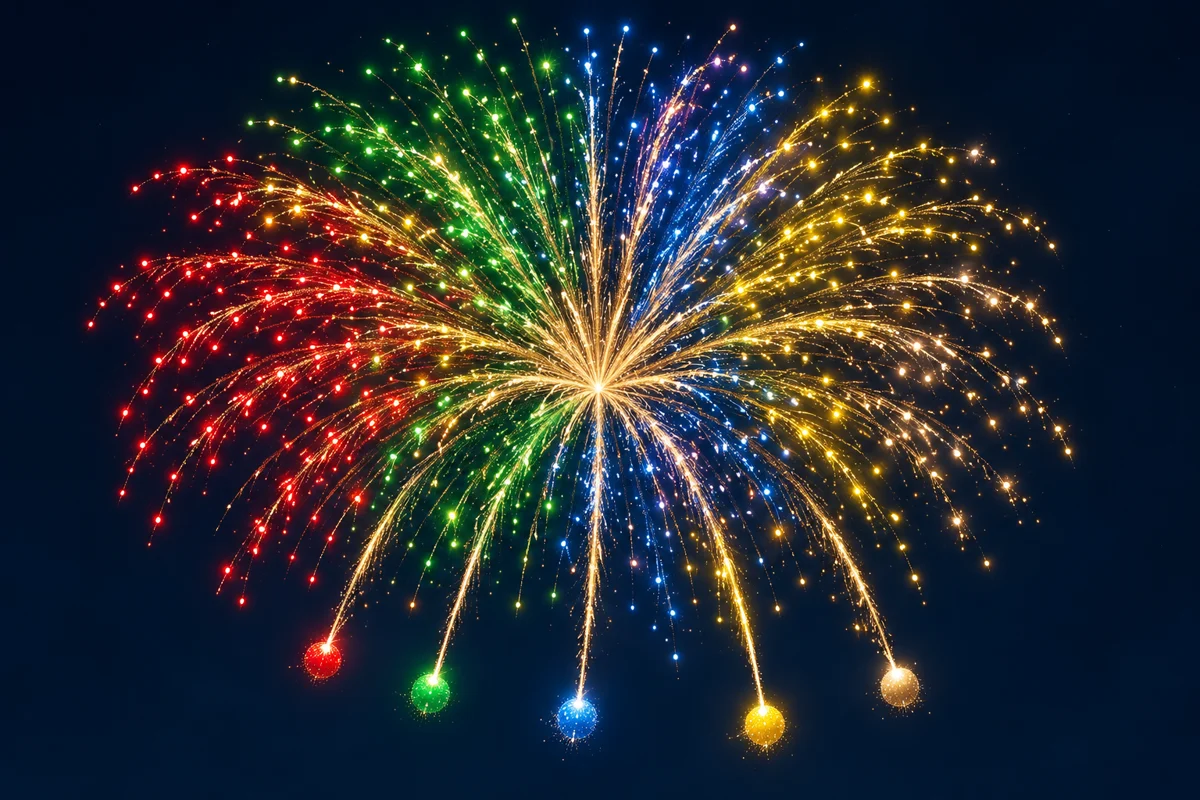
The “stars” inside a firework shell
A firework shell contains small pellets called stars. When the shell opens high in the sky, these pellets burn and spread out as bright dots or trails. They contain the materials that make the colors.
Color-making materials often contain metals such as strontium, barium, or copper. When a metal joins with other substances, it can form a compound. Some of these compounds are called metal salts. Here, “salt” is a chemistry name; it does not mean only the table salt we put on food.
Heat makes colored light
Atoms and molecules are tiny building blocks of matter. They contain electrons, which are tiny particles. As a star burns, heat can raise an electron's energy for a short time. When the electron returns to a lower-energy state, the material releases some energy as light.
The energy changes differ from one material to another, so the light they give off differs too. Our eyes see those differences as colors. In a real firework, the light can come from metal-containing atoms and from molecules formed as the materials burn.
Different colors need different materials
- Red: compounds containing strontium
- Green: compounds containing barium
- Blue: compounds containing copper
- Yellow: compounds containing sodium
These are common examples, not a rule that one metal always makes exactly one color. The materials used together and the way they burn can change the color we see.
Gold and silvery white can shine differently
Not all firework light comes from the same process. Tiny particles of iron or charcoal can become hot and glow gold. Metals such as titanium and magnesium can be used to make bright, silvery-white sparks.
Vivid blue is hard to make
Copper compounds that help make blue light are sensitive to the heat inside a firework. If it burns too hot, the molecules that produce blue light can break apart. The mixture has to burn at a suitable temperature, which makes a vivid blue difficult to produce reliably.
Sources
- Royal Society of Chemistry: Flame colours and how heat produces light
- U.S. Geological Survey: What minerals produce the colors in fireworks?
- Chemical & Engineering News: What’s in fireworks, and what produces those colorful explosions?
- Royal Society of Chemistry: Why blue is difficult to make in fireworks