How does a zipper open and close with one pull?
The short answer
A zipper’s slider guides the two rows of teeth. As it moves in one direction, it brings the teeth together to close the zipper. Moving it the other way separates them to open it. One small part can join or separate many teeth in a single stroke.
Three parts work together
A zipper has two fabric strips, called tapes; rows of teeth, called elements, along their edges; and a slider that travels over the teeth. The pull tab is attached to the slider, so moving the tab moves the slider too.
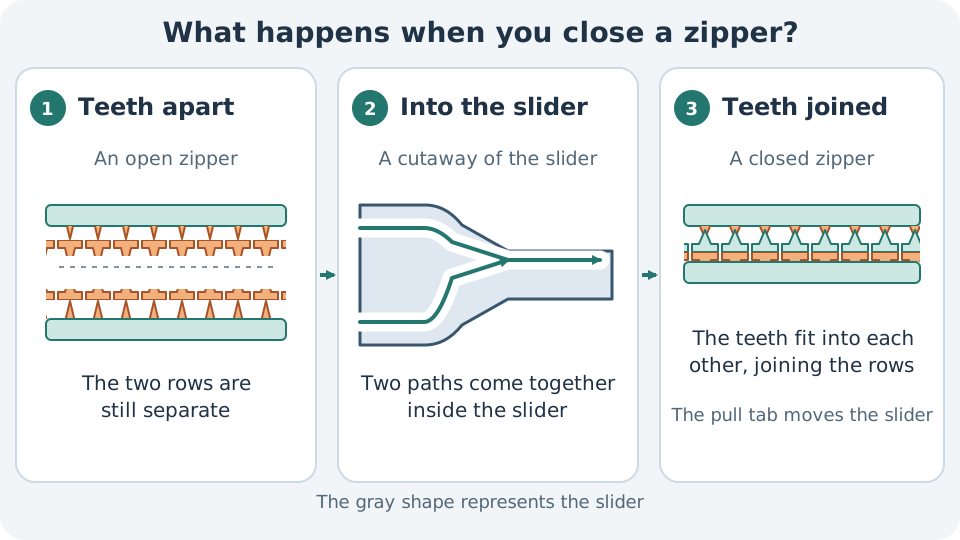
How does it close?
Inside the slider, a Y-shaped channel starts with a path for each tape and brings the two paths together. When the slider moves in the closing direction, it guides the two rows into one line. The teeth are shaped to fit into one another, so they catch each other and hold the rows together.
As the slider moves along, it keeps the joined section together and brings the next teeth into place. You do not have to fasten every tooth by hand because the slider guides both rows into position.
How does it open?
Moving the slider in the opposite direction sends the joined teeth into the part of the Y-shaped channel where the two paths spread apart. The rows separate, and their teeth come apart one by one. The slider turns one pull into a steady opening motion along the whole zipper.
Not all zipper teeth look the same
Some zipper elements are metal. Others use a continuous plastic coil or molded plastic teeth. Their shapes and how they are made differ, but the slider uses the same basic idea: it guides the two rows together to close them and apart to open them.
Why might a zipper fail to close?
If the teeth are out of line or their shapes no longer fit well, they may fail to interlock, and the zipper can open behind the slider. Fabric caught in the slider can also stop it from moving smoothly. Many small parts need to line up, so forcing a stuck pull can cause damage. It is better to move it back gently and check for caught fabric or misaligned teeth.