Why does paper come in sizes like A4 and A3?
The short answer
A4 and A3 belong to the A series of paper sizes. Each step from A0 to A1 and onward halves the previous sheet. The sides are chosen so that a half sheet keeps nearly the same shape. Shared sizes also make it easier to print, copy, and exchange documents.
Each step halves the previous size
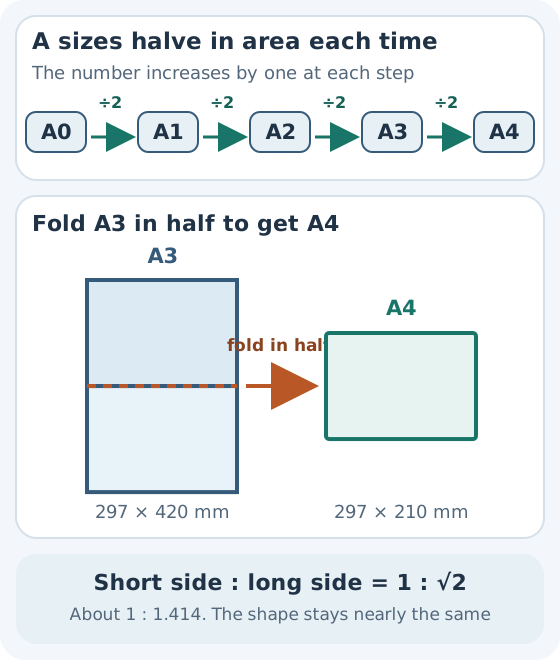
The A series starts with A0. Half of an A0 sheet is A1, half of A1 is A2, and so on. A4 is four halving steps after A0. Half of A3 is A4, and half of A4 is A5.
A0 is based on a sheet with an area of one square metre (the amount of flat surface on the sheet). Its dimensions are rounded to whole millimetres: 841 × 1,189 mm. A3 is 297 × 420 mm, and A4 is 210 × 297 mm.
Why does a half sheet keep nearly the same shape?
The long side of an A-series sheet is about 1.414 times its short side. This ratio is called the square root of two, written √2. You can simply think of it as “the long side is about 1.4 times the short side.”
With this ratio, halving the long side leaves the new sheet with nearly the same proportions as before. For example, if you fold an A3 sheet in half, the folded sheet has the dimensions of an A4 sheet turned sideways. The standard rounds measurements to whole millimetres, so the ratios are not perfectly identical; the difference is tiny.
How does this help?
Because the shape stays nearly the same as the size changes, a compatible printer or copier can enlarge an A4 page to A3 or reduce A3 to A4 while keeping its proportions. Shared dimensions also make it easier to choose paper, design printers, and store documents.
Not all paper uses A-series sizes
A standard is a shared set of rules that helps people make and use things in the same way. ISO 216 is an international standard for sizes of paper used in offices, commerce, and technical work. It includes A and B series. Not every sheet or printed item follows it: newspapers and books, for example, may use other sizes.
Key points
- A4 and A3 are part of the A series, which is made by halving A0 again and again.
- The side ratio keeps each half nearly the same shape as the sheet before it.
- Shared sizes make printing and sharing documents easier.