Why do plug shapes differ around the world?
Short answer
Household plugs and sockets follow standards set in different countries and regions. As electricity spread into homes, places chose their own shapes and safety rules. Those designs became part of buildings and appliances, so the differences remain today.
Plugs and sockets are designed as a system
The plug is the part on a cord that goes into a socket. The socket is the opening fitted into a wall or another surface. Their shapes and sizes must match so electricity can reach an appliance safely.
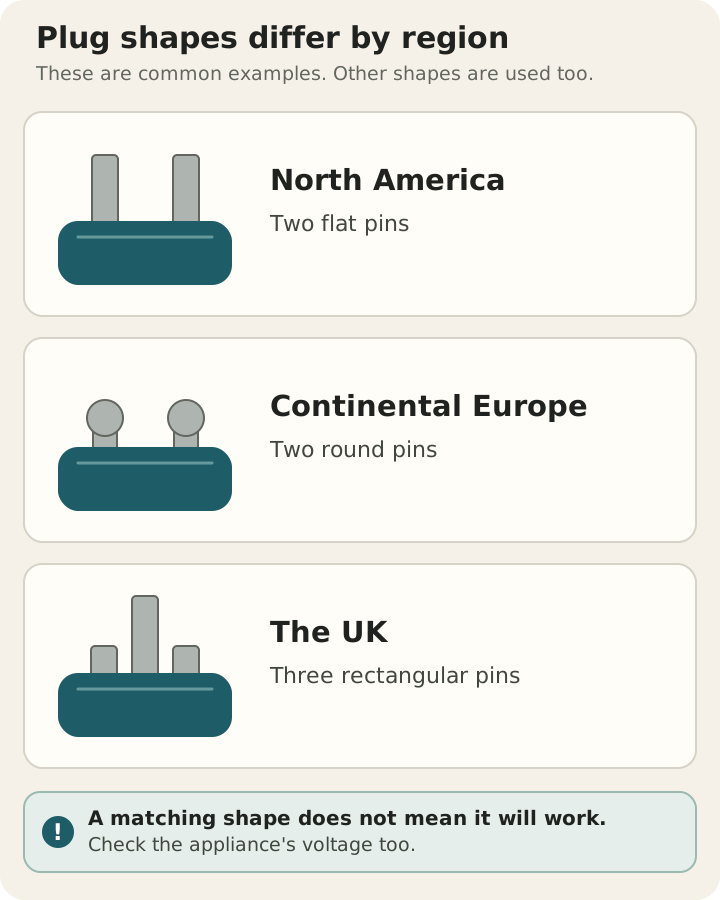
A standard is a shared set of rules for how something is made and used safely. Plug standards can set the number, spacing, and shape of the metal pins, along with safety features. For example, flat pins are common in North America, round pins are common in much of continental Europe, and the UK uses three rectangular pins. These designs reflect local electrical systems and safety rules, not just a choice of style.
Shape and voltage are separate things to check
Plug shape and the voltage or frequency supplied by a socket are related, but they are separate things to check. Voltage describes the electrical push that moves current. Wall power changes direction again and again; frequency tells how many times that pattern repeats each second. Japan and the United States both use plugs with similar flat pins, yet their household voltage is different: 100 volts in Japan and 120 volts in the United States. A plug that fits does not prove that an appliance can use the local electricity.
Why not use one shape everywhere?
The International Electrotechnical Commission (IEC) documents national plug systems and publishes international safety standards. Some safety standards set shared tests without choosing one pin shape. IEC 60906-1 does define a particular design for 200–250 V systems, but it has not become a universal plug shape.
Many sockets are built into walls, and appliances are made to match them. Replacing an established system would mean changing equipment in buildings as well as plugs on appliances, with a long transition. A 2017 European Commission opinion described the cost and waste that can come with changing systems tied to existing infrastructure.
Check the appliance before using it abroad
A simple plug adapter connects shapes. It is different from a voltage transformer. Read the “Input” label and the product manual to see whether an appliance supports the destination’s voltage and frequency. If the label is unclear, ask the manufacturer before choosing a transformer or using the device.
References
- International Electrotechnical Commission (IEC): IEC TR 60083 — National household plug and socket systems
- International Electrotechnical Commission (IEC): IEC 60906-1 — International household plug and socket system
- European Commission REFIT Platform: Opinion on differences in plug and socket-outlet systems in Europe (2017)
- Panasonic: Typical electrical conditions in major countries and regions